



As a mother to just one, nothing has been more glorious the past four years than nap time.
Quiet Time for Mom
In the early newborn and postpartum days, it meant an opportunity for me to get caught up on sleep.





Then in the toddler season, it meant at least one hour of pure quiet to decompress, attend to business needs, or tackle housework.
I have spoken with parents who transitioned their child out of nap time as early as two years old, and others whose preschoolers still take a short nap. I always hoped my child would be in the latter category. He has never been a good sleeper and for his first three years of life, it was apparent that a nap was necessary.
Then, shortly after his third birthday, he had his tonsils removed. This was a game changer. I mean LIFE ALTERING… for him, but also for my husband and me.
On the first night home, he slept through the night. And in the six months since, he has slept through the night nearly every night.
However, there was a trial period for the first six weeks after surgery. We were still doing nap time, but no matter how little we allowed him to sleep, he’d be up until 9:00 p.m. (or later) and up by 6:30 a.m. Then he’d be tired through the day, would fight a nap, but eventually fall asleep, and awaken for an additional seven hours in his day.
Transitioning Out of Nap Time
It was a vicious cycle. Finally, I’d had enough and cut the nap cold turkey. That first day, he was so tired, he went to bed at 7:00 p.m. and slept through the night. This was great! However, I quickly fell behind in my business and housework when I lost those two hours of quiet.
After a few weeks of this, I watched a vlog mom who indicated her children, of all ages, have scheduled quiet time every day. In that moment, I envied her. I became committed to building this into our daily routine even if it meant an additional battle to start.
And battle we did… but it was short-lived.
Now, without fail, my almost four-year-old has two hours of quiet time every day.
Our Schedule
Apart from Fridays, we abide by the following afternoon schedule during the week and on most weekends while at home:
- 11:30 a.m. – 12:00 p.m. → Lunch at the table
- 12:00 p.m. – 12:15 p.m. → Game or activity with mom/dad
- 12:15 p.m. – 12:30 p.m. → Read books with mom/dad
- 12:30 p.m. – 2:30 p.m. → Quiet time in room
- 2:30 p.m. – 3:30 p.m. → Snack and cartoon time
- 3:30 p.m. – 4:30 p.m. → Play or activity with mom/dad
Quiet Time Rules
Our rules for quiet time are simple, but rigid. My son must stay in his room for the entirety of quiet time, but what he does in his room is his decision.
Prior to beginning quiet time, we discuss what he wants to do, and I help him move whatever toys or activities he may want into his room.
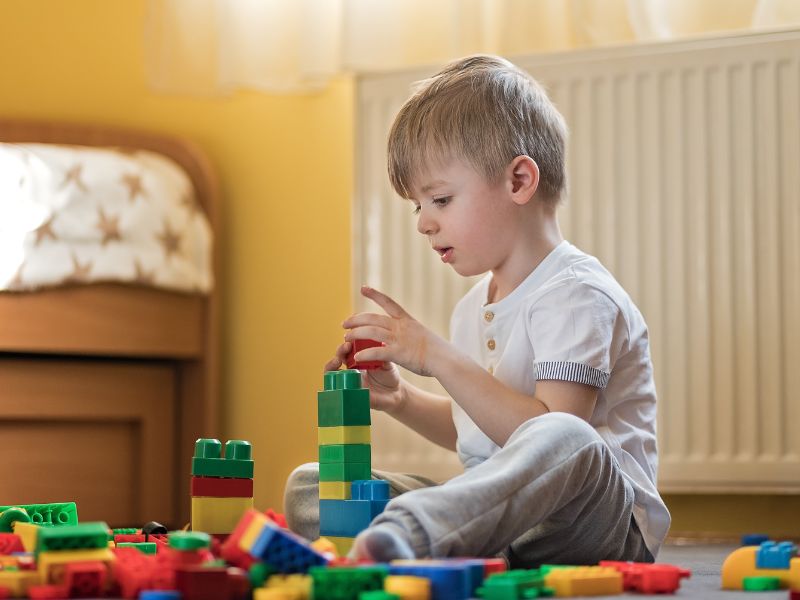
I do not limit his toy selection. I have even dragged the play kitchen across the house for him. Most days, he just wants his cars and ramps or his building blocks. His room is always home to his Toniebox, padded fort, puzzles, and various book collections, which all get used nearly every day.
Once I get him settled in, I ensure he has his blankets and a glass of water. Then, on my way out the door, I turn on the nap feature of his alarm clock. When his clock turns green (two hours after the feature is activated), quiet time is over and he is free to leave his room.
Communication
During many of his quiet times, I head downstairs to our office to work. His bedroom is directly above the office, so I can hear him playing and hear if he shouts for me. I come up and check on him about every 20 minutes or immediately if he gets too quiet.
At Christmas, he received a pair of walkie-talkies. And we have been practicing with them during quiet time: if he needs me, he pushes the call button on his and it rings on mine downstairs. As he becomes more familiar with the walkie-talkies, we’ll use them regularly when I’m in the office or, when weather warms up, step outside.
If he stays in his room the entire time and plays nicely, quiet time is deemed a success and he gets a reward.
Quiet Time Rewards
Two of my toddler’s favorite things in life are snacks and cartoons. Following a successful quiet time, he receives a snack of his choice and 45 – 60 minutes of cartoons.
If he is unsuccessful with the day’s quiet time, he gets a smaller snack (not necessarily of his choosing) and no cartoons.
What We’ve Noticed
With a few months of a quiet time schedule under our belts, we have noticed a positive change in our son’s sleep and behavior. He now goes to bed at 7:30 p.m. every night and sleeps until 6:30 a.m. with only the occasional nighttime waking — typically due to a nightmare or missing blanket.
In the mornings, he often discusses what he wants to do for the day’s quiet time and expresses excitement for it. He’s much like his dad in many ways, but his appreciation and need for alone time mirrors his mom.
By adding and consistently implementing quiet time in our routine, it has allowed me the time I need to recharge for the remainder of the day. When he walks out of his room feeling refreshed from quiet time, he is greeted by a mom who is equally refreshed and excited for the day’s next adventure.